Is anyone actually enjoying social media anymore?
Beat social media fatigue by curating, not scrolling. Dewey organizes your saved posts into a searchable library for genuine enjoyment.
Ask this question to anyone who spends a considerable amount of time online, and you will probably hear a conflicting answer. In the past, social media was seen as a technological revolution and as virtual spaces for connection, discovery, and communities. Nowadays, for many users, it seems more like a commitment.
The algorithms seem arbitrary, the reach is getting more and more irregular, and the pressure to constantly present yourself to an invisible audience is exhausting. However, billions of people are still online. So, what has changed? Or is there a better way to use social media?
The answer doesn't have to be so radical, like "abandon social media completely!" Fundamentally transforming the way you interact with them and carefully choosing the content you consume can be a good start.
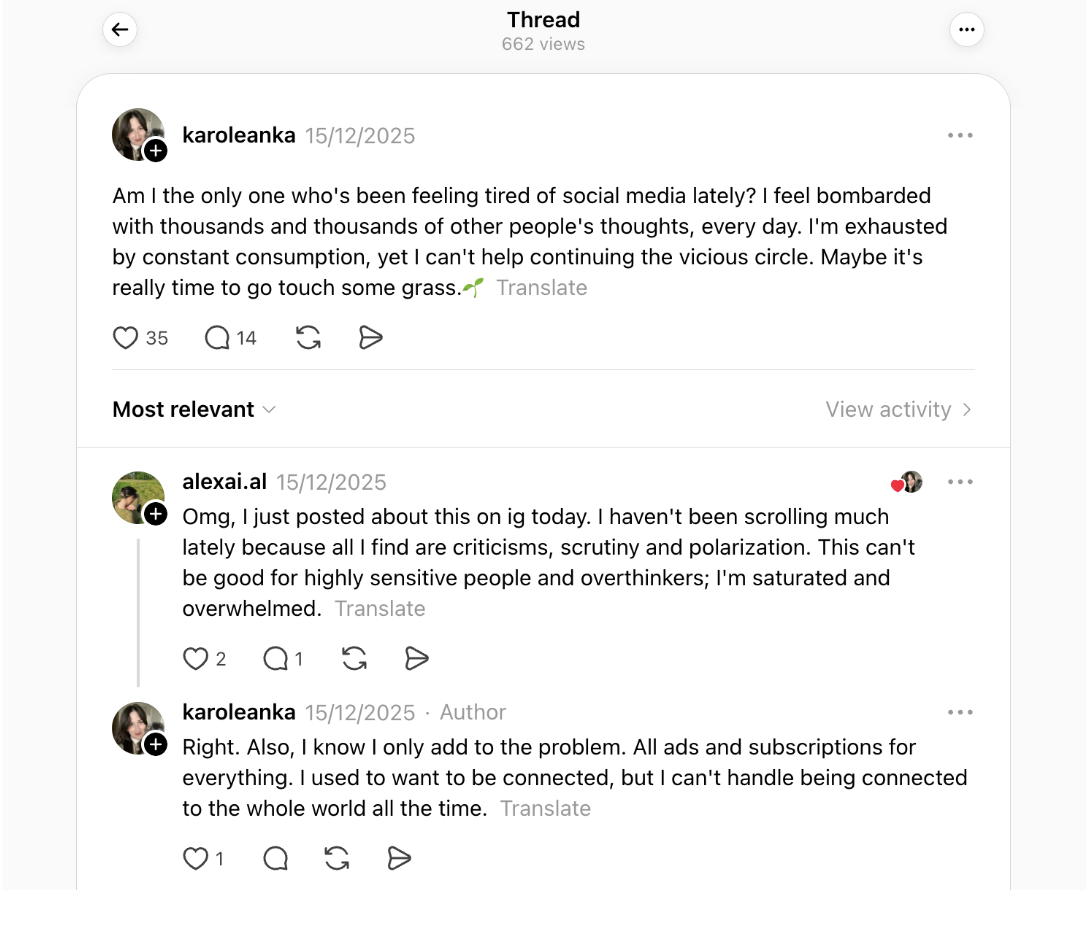
The social media fatigue
The disillusionment with social media is not fictional. It is happening as a widespread and well-documented change. Creators and regular users are reporting a growing sense of frustration with platforms they once loved.
Organic reach on platforms like Instagram and Facebook has drastically decreased in recent years as well. Currently, a post that reaches only 10-20% of one's own followers can already be considered "successful." This is a devastating scenario for companies and independent creators who are still building their audiences on these platforms.
The social media feeds are also a chaotic mix of sponsored posts, algorithmic recommendations, trending content, and clickbait on controversial topics. The fortuitous discovery of genuinely interesting ideas, which was a very cool feature in the early days of social media, has largely been replaced by content designed solely to maximize engagement metrics.
That's why many users are describing the experience of being online on the platforms as a burden rather than a pleasure.
The antidote to algorithmic chaos
What some users are trying to do to manage this discontent is to stop trying to consume everything and start curating intentionally. Instead of passively scrolling through the feed and waiting for the algorithm to deliver something valuable, they actively build collections of content that reflect their interests, values, and goals.
Here's how this intentional curation works in practice:
-
Save content with purpose. Mark only what you truly intend to use, not just anything that catches your attention.
-
Organizing by theme. Group the saved content into folders or tags so that you can focus on one theme at a time, or to make it easier to search for later when needed.
-
Regular check-up. Take some time to revisit all the saved content every week or month, so you don't end up piling up unnecessary content.
When you approach social media as a curator instead of a consumer, the entire experience changes. You are no longer at the mercy of an algorithm deciding what you see. You build a personal library of ideas that truly matter to you.
The bookmarking problem
Despite the frustrations, social media remains one of the best sources for discovery. Every day, users stumble across brilliant articles, useful how-to threads, inspiring creative work, and insightful comments.
In these moments, they save these posts and tell themselves they'll come back to them. In reality, they rarely do, and that's how bookmarks start piling up into an uncontrollable archive.
That thread about productivity you saved six months ago? Gone. The article on modern art you bookmarked last Tuesday? Lost in a sea of thousands.
Most people have hundreds, even thousands, of saved posts they will never locate again.
This is also one of the problems that can be stressful about social media. When you finally find good stuff, you can't keep it in sight, because it gets buried under the platform's dysfunction.
How Dewey turns bookmarks into a usable collection
This is exactly where Dewey comes in. Dewey is a tool built specifically for social media, taking the content you have already saved on platforms like Bluesky, LinkedIn, Instagram, TikTok, and Reddit, and transforming it into an organized, searchable, and genuinely useful collection.
Think of Dewey as a filter between the chaos of social media and your interest in content that makes sense to you. Instead of seeing your bookmarks disappear overnight for different reasons, use Dewey to gather everything in a single panel, searchable by keyword, tag, author, or date.
AI-powered tagging at scale
One of the most useful features of Dewey is the AI tagging system. You can type keywords about your interests, and Dewey's algorithm automatically tags thousands of favorites in seconds. The AI also learns your preferences and adjusts its suggestions to your categorization style over time.
Building collections you can actually share
Dewey also allows you to create collections to share publicly through shareable URLs. This is where curation becomes a social act in the best sense, where you can be an editor and share well-organized collections with whomever you want. There are also export options, including CSV, searchable PDF, and Google Sheets.
Cross-platform
Dewey works on various social media platforms and solves the problem of fragmentation between them. Your bookmarks from Instagram, TikTok, and LinkedIn can all be in one place.
Make the most of social media
People who still really enjoy social media are trying to find ways to filter out the unnecessary noise. They follow only people they like and admire, and save and organize the content that really matters to them. Thus, social media becomes less like a compulsive feed scrolling session and more like a deliberate tool for research and inspiration.
The main perception is that the value of social networks has never been in the feed, but rather in the connections and ideas you can find there. The feed is just one of the delivery mechanisms. If you are able to extract the good from it and build something lasting, social media can become a tool instead of a trap.
Dewey makes this possible for you, helping you regain your digital attention. It takes the scattered and forgettable markers you have accumulated and transforms them into an extension of your memory and brain.
The remedy for social media fatigue
Is anyone really enjoying social media anymore? The answer is yes, especially for people who stopped trying to enjoy everything at the same time and started focusing on what really matters. The shift from passively scrolling to intentionally engaging with content and actively building collections of relevant posts is the difference between feeling drained by social media and feeling enriched by it.
If your saved posts tab is a graveyard of good intentions, it's time to give them a second life. Dewey can help you with that, turning your bookmarks into something you'll actually use later. After all, they deserve more than to be forgotten. You too.